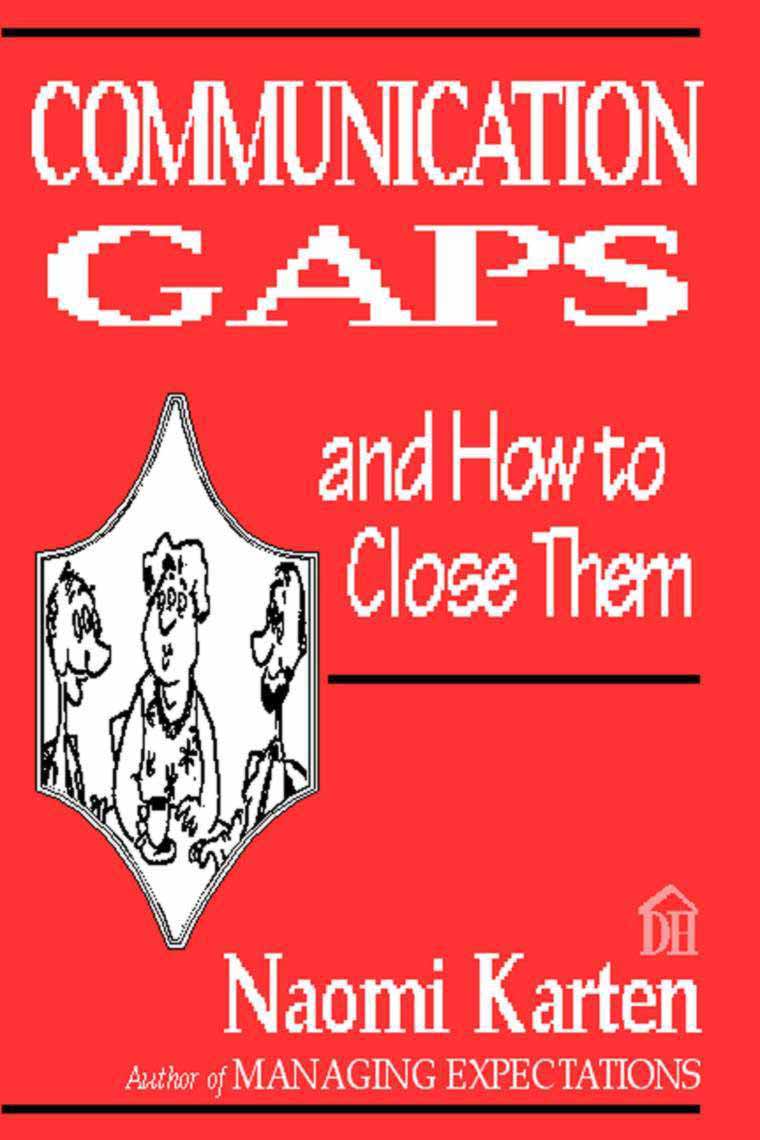
COMMUNICATION
GAPS
AND
HOW
TO
CLOSE
THEM
Dorset House Publishing, 355
pp., ISBN 0-932633-53-6
$34 plus shipping
Whether you manage people or projects, communication is crucial.
How often, though, have you found yourself shouting across communication
gaps that have widened into yawning chasms?
This book will help you use communication as a tool for successfully
carrying out projects, delivering service, implementing change,
strengthening teamwork, building relationships and dealing with
everyday miscommunication.
Here's an
excerpt on communicating during times of
major technological or organizational change.
TO ORDER this book, contact my
publisher,
Dorset House.
Here is an overview of the contents:
INTRODUCTION
SECTION 1: Gaps in Everyday Interactions
2. Getting Through: Responsibilities of the Sender
3. Misinterpretations: How Messages Cause Confusion
4. Untangling Tangled Interactions: Reaction of the Recipient
SECTION 2: Gaps in Building Relationships
5. Building a Strong Foundation
6. Appreciating and Benefiting from Communication Differences
7. Understanding the Other Party's Perspective
8. The Care and Feeding of Relationships
SECTION 3: Service Gaps
9. The Communication of Caring
10. Gathering Customer Feedback
11. Service Level Agreements: A Powerful Communication Tool
SECTION 4: Change Gaps
12. The Experience of Change
13. Changing How You Communicate During Change
CLOSING CHAPTER:
14. On Becoming a Gapologist

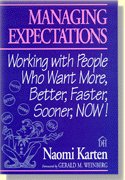
MANAGING
EXPECTATIONS:
Working With People Who Want More, Better, Faster, Sooner,
NOW!
Foreword by Gerald M. Weinberg
Dorset House Publishing, 240
pp., ISBN 0-932633-27-7
$28 plus shipping
TO ORDER this book, contact my
publisher,
Dorset House.
Expectations are impossible to
turn off. But you can improve your ability to manage them, and thereby
dramatically improve your service effectiveness. This book takes a serious,
lighthearted look (yes, both!) at the impact of expectations, and what you
can do to manage them better.
Here is an overview of the contents:
INTRODUCTION: The Expectations Challenge
SECTION 1: Communications
1. Guard Against Conflicting Messages. How not to create unintended messages
2. Use Jargon With Care. Speak to your listener's level
3. Identify Communication Preferences. One method does not serve all
4. Listen Persuasively. When listeners listen, talkers talk
SECTION 2: Information Gathering
5. Help Customers Describe Their Needs. Use the "that's not it" strategy
6. Become an Information-Gathering Skeptic. Challenge your assumptions
7. Understand Your Customers' Context. Study the problem before you solve it
8. Try the Solution on for Size. Why the specification is not the solution
SECTION 3: Policies and Practices
9. Clarify Customer Perceptions. Believing is seeing
10. Set Uncertainty-Managing Service Standards. Respect your customers' wait state
11. When Appropriate, Just Say Whoa. How to say no so it sounds like yes
12. Build Win-Win Relationships. Win friends and influence customers
CONCLUSION: Formulate an Action Plan.
How to be a great expectations manager
SLA HANDBOOK AND GUIDES
These resources draw from more than a decade of experience consulting and presenting SLA seminars internationally, and are
designed to help you avoid the flaws and failures many
organizations experience. These items will help you understand:
- What makes an SLA work well or not so well
- The key elements of an SLA and their functions
- How to plan, develop and manage an SLA
- The types of wording to use and to avoid
- The pitfalls to guard against
- What to look for in critiquing an SLA
- How to be successful in establishing your SLAs
TO ORDER any of
the following, download this order form
or contact me at 781-986-8148 or by
HOW TO
ESTABLISH
SERVICE
LEVEL
AGREEMENTS
A 172-page handbook (eBook) in pdf
format
Download a 33-page
excerpt.
$59
3 SLA
GUIDES
21- to 24-page eBooks in pdf format
$19 each
- Why SLAs Fail and How to Make Yours Succeed: a guide
that describes the key factors that cause SLA failure and offers
guidelines and recommendations to help you succeed where others
have not
- How to Critique and Strengthen Your SLAs: a guide that offers criteria and guidelines for evaluating and improving existing SLAs and SLAs under development
- An SLA Template and How to Use It: a guide
that provides a detailed template, along with guidelines and
recommendations for its use -- plus a copy of the template in
Word format so that you can enter your text directly into it.
FYI, here is an overview of the SLA handbook:
Chapter 1. Service Level Agreements: Role and Key Features
Case study: analysis and recommendations
What a service level agreement is and is not
The parties to an agreement
Key participants in establishing an SLA
Variations in SLA focus
Benefits of an agreement
The role of the SLA in reducing uncertainty
Initiation of a service level agreement
How long should a service level agreement be?
How long should an SLA take to establish?
When not to establish an SLA
How to make an SLA fail!
Remember the human factor
Chapter 2. The SLA Document and Process at a Glance
The SLA document vs. the SLA process
The key elements of an SLA document and their functions
A template outline
The administrative elements
Elements of a contractual SLA
SLA process: Critical initial steps
SLA process: Development checklist
Chapter 3. Exercise 1: Evaluate a Sample Agreement
How to evaluate this agreement
Sample agreement
Observations about this agreement
SLA evaluation: an important caveat
Criteria for evaluating an SLA
Chapter 4. The Service Elements of an SLA
Overview of the service elements
Service element #1: Context-setting information
Service element #2: Description of services
Service element #3: Service standards
Categories of service standards
Caveats about selecting service standards
Analysis of two service standards
Service dependencies and service exceptions
Escalation paths
Division of responsibilities
Real-time service standards
Chapter 5. The Management Elements of an SLA
Overview of the management elements
Management element #1: Service tracking & reporting
What to track: objective and subjective measures
Recommendations for service tracking and reporting
Management element #2: Periodic review
Objectives, methods, and frequency
Management element #3: Change process
Creating a change process
Chapter 6. Exercise 2: Evaluate a Sample Agreement
How to use this agreement
Evaluation criteria: another approach
Model agreement
Points worth noting about this agreement
Chapter 7. Critical Initial Steps
Step 1: Assess whether an SLA is appropriate
Step 2: Ensure management commitment
Step 3: Designate SLA managers
Step 4: Provide SLA education
Chapter 8. Development Checklist
Step 1: Assess current services
Step 2: Gather customer feedback
Step 3: Ensure agreement about the agreement
Step 4: Develop a draft SLA
Step 5: Solicit feedback from reviewers
Step 6: Implement and manage the agreement
Chapter 9. Products and Services by Naomi Karten
Overview of products and services
Training in how to establish an SLA
SLA consulting support
Seminar on Establishing Service Level Agreements
Articles on Establishing Service Level Agreements
SLA FAQ page
|